|
GARRY’S ANCHORAGE, FRASER ISLAND—ENGULFED BY DUST...continued |
|
BACK to Masala Home Page |
|
BACK to Masala Cruise Log |
|
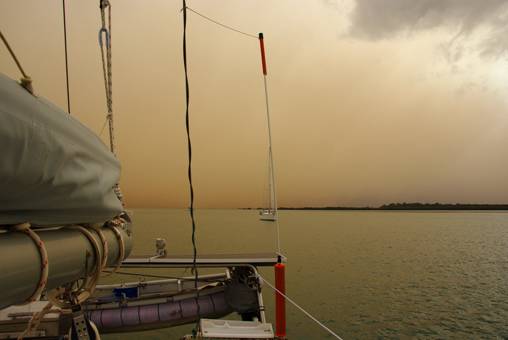
Fortunately most of the wind petered out before it got to us, but the dust was choking. Overnight, our beautiful new grey boom bag was converted to an old reddish-grey one. The fine powder covered everything. Fortunately our insect screens reduced the quantity coming inside, but in the process they had turned bright orange. As we moved about Masala’s decks, we turned orange ourselves as our clothing came in contact with the boat’s surfaces. |
|
To add to the misery, two huge fires started on Fraser Island near us, and the smoke poured over the water and mingled with the already disgusting dusty air – a truly foul mix. The ship’s log records some of the drama:
We are currently anchored about half way up the Great Sandy Straits, opposite Fraser Island. Maybe they should be renamed the Great Dusty Straits, as we are enduring our third day of dust storms. Everything is covered in orange filth. Each morning we have to wipe down the cockpit so we have somewhere to sit without turning too brown. We have to wear different clothes inside the boat to outside so that the interior isn’t ruined, although there is a slowly growing film of dust inside too.
The bushfires burning across the way on Fraser Island add smoke to the brown soupy atmosphere, reducing visibility and creating a level of pollution the like of which we have never seen before. The dust and smoke laden atmosphere has been with us for days. It just won’t go away. The wind continues to blow from the W to SW, bringing yet more dust. It is if our land is dying.
It is a waste of time trying to clean anything due to the continual fallout, so we have to live in filth. The only item which is regularly cleaned with a little precious fresh water is our solar panel bank, from which we need every bit of energy we can get. The water left in the bucket after cleaning the panels would be ideal for growing rice. Will it ever end? Can our country survive the effects of climate change, or is it destined to become a vast desert? |
|
Above: advancing dust storm seen from Masala’s decks |
|
Listening to the radio the other night, we heard the farmer’s representative from the Riverina region in inland NSW saying that they had zero allocation of water this year so there would be no rice crop. It is Australia’s largest rice growing area, but the huge rice processing plant being maintained by skeleton crew has not processed a crop in three years. Then the rep went on to say that they were poised to plant when the drought broke. Spoken with such certainty, because droughts have always broken in the past.
The Bureau of Meteorology has always used long term records from past years to produce a long term forecast of likely conditions for the coming year, to help farmers and others whose businesses are dependent on the weather. The process is called “hindcasting” and is a venerable and well proven technique. Recent weather patterns are matched to similar patterns in the past, then what happened subsequently in the past is used as the basis for the “forecast”. Recently, the Bureau publicly announced they were scrapping this method entirely because past weather patterns are no longer an indication of future weather patterns.
How long can we continue to grow rice in a desert, fed from a river system which doesn’t receive any rain? “Food” for thought. |