|
A DREAM COMES TRUE AT LADY MUSGRAVE ISLAND |
|
BACK to Masala Home Page |
|
BACK to Masala Cruise Log |
|
9-17 SEPTEMBER At 08:00 in the morning we were off the reef at the southern end of Lady Musgrave Island. The lagoon surrounding the island is one of the very few in the entire Great Barrier Reef where it is possible to get a vessel inside. |
|
Our problem was that we’d arrived 7 hours before this time. We’d have to wait until 3 p.m. So we dropped all sail and allowed Masala to lie a-hull. This means she was left to float around at her whim, not under control. Due to the strong tides we had to start the engine and motor back into the lee of the reef about every hour. |
|
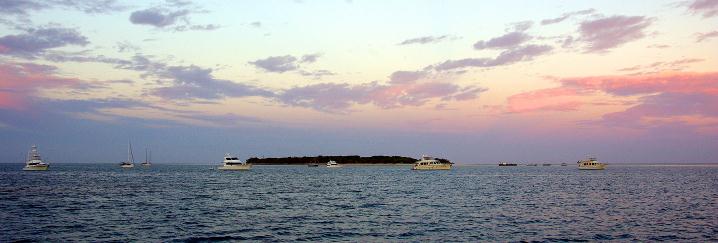
Above: early morning light over Lady Musgrave Island |
|
The entrance is a narrow slot through the coral wall, through which the tide rushes at breakneck speed. The interior of the lagoon is dotted with coral “bommies” which must be avoided. If you haven’t been there before, it is safest to enter the lagoon near slack water low tide, so the current is weak, the walls of the entrance slot visible, and the bommies easy to see. Visibility into the water is greatly assisted by a high sun angle. |
|
Right: a long wait before we can attempt the entrance into the lagoon |
|
By 2 p.m. we were sick of waiting so motored to the entrance. It was an intimidating sight. The lagoon is massive at 5 km long and 12.5 square kilometres in area. Once the water level inside falls below the top of the encircling coral walls, the only way for it to escape is to pour out the entrance channel. This it was now doing, churning up the ocean for 100 metres out to sea as it did so, driven by the extreme tide.
Perhaps foolishly, we decided to run the gauntlet anyway. We were spun this way and that in the wash outside the entrance. Then with each metre into the channel the current got faster and faster until, with engine flat out, we could barely make 1.5 knots progress. It seemed to take forever to inch past the jagged coral walls. Steering was critical since the slightest misalignment with the current meant the bows would be swept aside and control completely lost. There was no time to think, impossible to turn, we were committed. At the inside end of the channel the current suddenly lost its grip and we popped into the lagoon like a cork out of a champagne bottle.
Would we do that again? No! It would have been better to wait for low tide (another hour) or a bit longer for slack water. But now that we’ve been in once we would have no hesitation coming in at half tide or more, the advantage being that water is able to flow in or out over the coral walls all around the lagoon, rather than being forced through one small channel. |