Cruising Log—24...Pancake Ck to Fraser Island |




|
After breakfast I was asleep in the sea berth in the saloon when I was awakened by a bang and a loud shout for help from Leanne, who was on watch. “What’s happened?” I yelled, as I pulled on some clothes. My fear was that part of the rigging had broken. “I’m not sure,” Leanne said, “but the mainsail has fallen down.” I came out on deck to be greeted by a great white cloud of sail everywhere, battens tangled in the lazy jacks, reefing lines caught on deck hardware, what a mess. A quick look at the top of the sail showed a shackle and about 20cm of halyard – the rope had broken where it comes over the pulley in the top of the mast. The rest of the halyard had disappeared back into the top of the mast. There was no way we were going to be able to get it out. So we had no choice but to remove it by pulling it all out of the bottom of the mast, otherwise it might have fouled something else. |
|
We needed to sail ESE and once again, the wind was from the ESE. So it looked like a long day and night of tacking. In reality we were lucky. After a starboard tack of several hours to the north-east to get us offshore (effectively going backwards all the while) we changed to the port tack. Initially we couldn’t get any further offshore, we just tracked parallel to the coast, but during the afternoon and evening the wind ever so slowly backed to the north-east. We sailed a huge curving port tack about 80nm long, hard on the wind the whole way, but by dawn the next morning we were celebrating as we just managed to clear Breaksea Spit. From there we could head south towards Fraser Island with eased sheets and the wind behind us. |
|
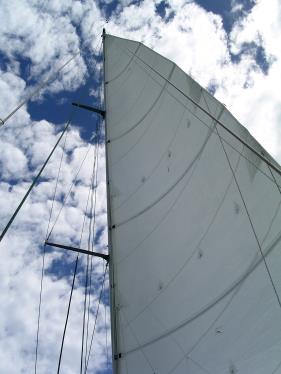
Fortunately Masala was built by a man who works with one of the leading riggers in Melbourne, and he had rigged the mast with a spare main halyard (there is also a spare genoa halyard). Trouble was, the spare halyard came out on the opposite side of the mast. We had to disconnect the boom vang and move it to the other side to make room. The vang lines ended up twisted and crossed over each other – it wasn’t pretty, but it would have to do. After untangling the battens from the lazy jacks, we finally got the main back up again. |
|
After all that effort, at 10 a.m. the wind died and the sea glassed out. We floated around and waited. The tide began to push us towards Breaksea Spit. We waited some more. It was very hot. The spit came closer. The wind just wouldn’t blow. At 3 p.m. we listened to the updated weather forecast. Suddenly our weather window was gone! Next day we would now have 30kts from the north and the following day 30kts from the south, with 3m seas on a 2m swell. What on earth to do? Depends on when the wind starts blowing again. |
|
We were going to stop at Big Woody Island, the only shelter from northerly winds, but when we got there the wind was from the north-west and it was no good. We had to keep going. It was difficult sailing dead downwind with no room to manoeuvre, and lots of gybes were needed to accommodate slight changes in the direction of the channel. This brought on the inevitable, an unintended gybe that broke the boom preventer. But that was OK, I designed it to break under these circumstances and it was soon fixed and reinstalled. At this point I went into a blind funk with tiredness and stress, but the Commodore saw me through the worst of it and we struggled on. |
|
Well, we didn’t get a puff until 8 p.m. that night. With our window gone, we had no option but to turn around & sail back up and around the top of Breaksea Spit then down past Bundaberg and into the Sandy Straits. It took all that night and all the next day to do this. We rocketed past Urangan and into the straits about 4 p.m., absolutely dog tired and very stressed. We had a howling tail wind, an ebb tide, and nasty little seas, but Masala was still going fine, unlike the sailors on board. |