Radford 415 Design—Continued 2 |
|
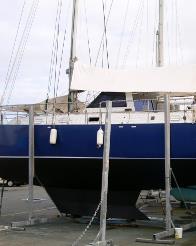
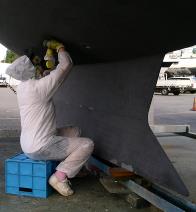
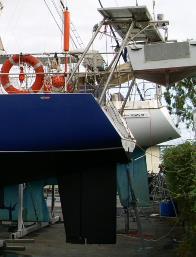
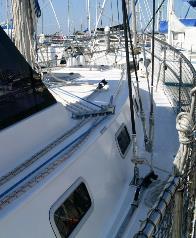
Full length keel—Advantages Easy to steer at sea in difficult conditions; very strong; suited to modest draft. Full length keel—Disadvantages Hard to maneuver in confined spaces; slower speed when sailing due to large wetted area. Deep fin keel—Advantages Easier to maneuver in confined spaces; faster when sailing due to smaller wetted area. Deep fin keel—Disadvantages Harder to steer at sea in difficult conditions; more vulnerable to impact damage; often requires deeper draft, which can affect access to some cruising grounds. Draft A deep draft may improve sailing performance and stability, yet in cruising yachts it can be a handicap as they spend the majority of their time in shallow coastal waters. Placement of the ballast is just as important—the lower in the water, the better—thus the trend towards lead bulbs. The Radford 415 achieves both a modest draft of 1.75m (5’9”) and excellent stability through its keel design—the longish keel and flared toe keeps the 4 tons of lead ballast relatively deep in the water, allowing shallower draft than many comparable vessels. Rudder Protection of vulnerable underwater components such as the rudder are very important in a cruising yacht, which may find itself far from help. The Radford 415 rudder has three bearing points on the rudder shaft for extra strength, and is physically protected by a full-length skeg. Staying Dry One of the main advantages of a properly constructed steel yacht is its internal dryness, a consequence of all-welded construction. For example, toe rails are an integral part of the structure, not bolted on. Nor are there any bolts attaching the hull to the deck. Deck fittings are bolted, but into blind holes that have been drilled and tapped into plates welded to the deck. Chain plates are also welded. Thus the welded steel boat does not have hundreds of holes in it as other materials do, all of which become potential leak points as the boat and the sealant ages. Masala has been built in this fashion (see The Yacht… Construction). Maintenance Maintenance (specifically rust) has often been quoted as a disadvantage with steel boats. This can be true of old steel boats and/or ones that have not been properly painted in the first place, both inside and outside. However, huge advances have been made in recent years in protective coatings for steel. The important thing is that the steel yacht’s paint system is fully documented, of high quality, and properly applied. Such is the case with Masala (see The Yacht… Full Specifications). A well-painted steel yacht with no external timberwork, such as Masala, is very easy to look after and stays looking good during long periods of absence.
|